
Prime Minister Manmohan Singh will raise with President Barack Obama next month concerns over the recent decisions by the United States on visa rules and outsourcing amid hopes that these would not affect the rapidly growing bilateral ties.

Weeks after 'breakthrough', substantial work is yet to be done

'When you think back to the promises made 10 years ago, not a single one of those had panned out to date.'
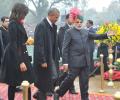
'Reviving the nuclear deal was crucial before the Obama visit... It was time for the BJP to admit that it was wrong, and redo the civil nuclear liability laws.'
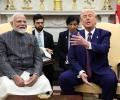
From bhikshus of Ashokan 3rd century BC and medieval Sufis to Oxfam, Omidyar and Soros now, non-State actors have any real power only when they work in conjunction with a real State, asserts Shekhar Gupta.

There are many reasons for Japan to turn a deaf ear to its anti-nuclear lobby and concentrate on its geo-strategic imperatives to sign the nuclear deal with India, says Debalina Ghoshal.

Indian and American experts on Wednesday held detailed discussions on a range of implementation issues, including administrative, liability, technical and licensing matters to advance the operationalisation of Indo-US civil nuclear cooperation that has been in limbo for past 9 years.
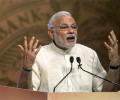
Modi has made nuclear power a key element of his clean energy strategy
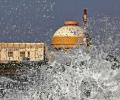
This would make India the world's second-biggest nuclear energy market after China
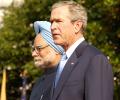
'If we could break through this symbolic barrier of sanctions and a dysfunctional relationship, we could do anything.'
Left parties on Wednesday warned the government that it would commit an "illegal act" if it tried to dilute the Civil Nuclear Liability Act or signed any agreement for supply of nuclear reactors during the upcoming United States visit of Prime Minister Manmohan Singh.

In first high-level engagement between India and Russia after National Democratic Alliance government came to power, External Affairs Minister Sushma Swaraj and Russian Deputy Prime Minister Dmitry O Rogozin on Wednesday held extensive talks on crucial bilateral issues including trade and energy security.
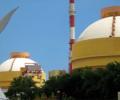
Legal hitches appear to have cropped up in the plans to set up two new reactors in the Kudankulam Nuclear Power Project and a commercial agreement on it is unlikely to be signed at the Annual Summit between Prime Minister Manmohan Singh and Russian President Vladimir Putin in Moscow on Monday.

India and the United States on Sunday achieved a breakthrough in operationalisation of the stalled nuclear deal
'Trump administration wanted a positive tone at this summit, but there was still some anxiety that there could be some awkward moments -- and there were not.'

'There has definitely been a breakthrough in the nuclear logjam. It is good to see nuclear energy back on the rails,' says Dr Anil Kakodkar, former chairman, Atomic Energy Commission.
The government indicated on Wednesday that it would hold discussions with the Bharatiya Janata Party and Left parties, which had opposed the Nuclear Liability Bill, and did not rule out the possibility of raising the compensation cap of Rs 500 crore as envisaged.
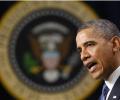
'By his very presence in Delhi on Republic Day, Obama is revisiting the most defining relationship of the 20th century after a period of stagnation,' says Ambassador T P Sreenivasan.
Particularly in the wake of allegations levelled in Parliament against the Congress and the government by its one-time friends and allies, Rashtriya Janata Dal chief Lalu Prasad Yadav and Samajwadi Party chief Mulayam Singh Yadav, that the CBI has agreed to give a clean chit to Gujarat Chief Minister Narendra Modi in return for the BJP support.

'The biggest lacuna in this agreement is it is called 'full civil nuclear cooperation agreement.' Actually, it is anything but full.'

India has a 'natural global partnership' with US, says PM.
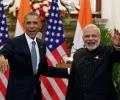
About 4 GW of new nuclear power capacity is under construction in India
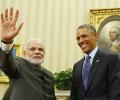
With their landmark 2005 civil nuclear deal still in limbo, India and the United States have established an inter-agency contact group to sort out outstanding liability and technical issues to fast-track its full implementation.

BJP president Rajnath Singh has said that if the party comes to power in the next general election, its foreign policy wouldn't be much different from that of the Congress government. Aziz Haniffa in Washington

Prime Minister Narendra Modi and US President Barack Obama on Sunday held talks on a range of crucial issues, including removing hurdles in operationalising the long-stalled civil nuclear agreement and enhancing ties in defence, trade and commerce and climate change.

On the final day of Prime Minister Narendra Modi's visit to the US, that country on Tuesday extended its Defence Cooperation Agreement with India by another 10 years. The pact, which was to expire in June next year, will now be in force till 2025.
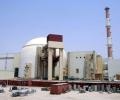
The contract would give a big boost to India's $150 billion nuclear power programme, and a broader push to curb greenhouse gas emissions.
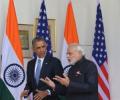
It is for the companies and the industry to ascertain where they want to run with the US-India civilian nuclear agreements reached by Washington and New Delhi, says United States Assistant Secretary of State Nisha Biswal. Aziz Haniffa reports for Rediff.com from Washington, DC

'Modi's investment in the relationship with Washington is the biggest deliverable of this visit. He means business and that's fantastic!'

Several nuclear power projects held up for the lack of such an insurance pool can now be expected to move forward.

'Modi and Obama both had agendas that went beyond the nuclear deal. The threat from the chilly Himalayas had to be tackled in the warm waters of the Indian Ocean.'
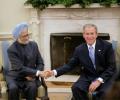
'The nuclear deal required Prime Minister Manmohan Singh to gamble the future of his government on a vision for the future of his nation.'

US Assistant Secretary of State for South and Central Asia Nisha Desai Biswal believes the India-US nuclear deal is not in limbo and it is for India and Pakistan to set the pace for conversations to resolve their issues. Rediff.com's Aziz Haniffa reports from Washington, DC.

United States President Barack Obama on Sunday arrived in India for a highly anticipated three-day landmark trip during which the two countries will strive to make progress on climate change, defence and economic cooperation.

... And it's not just fear of job losses, says Ajit Balakrishnan.

Western businesses and diplomats in Delhi privately say Modi's reputation as a man of action has been hurt by setbacks on economic reform.
'One thing I've learned about nuclear power is that these are not fast kind of time-lines.'
Prime Minister Manmohan Singh departed for an official visit to the United States on Wednesday morning in what could be a last opportunity to recover his crumbling legacy. A host of issues are tied to what could be accomplished on this trip; that the stakes are high is evident from how carefully the government is downplaying whether or not anything can be accomplished.
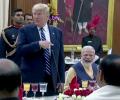
'Many said his visit was very risky. But mercifully, Air Force One has taken off from Delhi without Mr Trump stepping on anybody's toes,' notes Ambassador T P Sreenivasan.

The first unit of the Kudankulam Nuclear Power Plant was synchronised with the southern power grid on Tuesday, marking a major milestone in power generation of the ambitious Indo-Russian nuclear collaboration in Tamil Nadu.
